
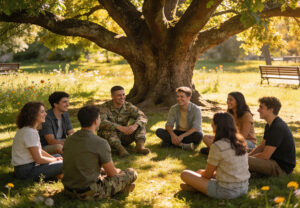
An In the News Reflection on Suicide Risk, Belonging, and Community Care
Recent findings highlighted in VA Research News Briefs underscore a critical truth about social adversity and suicide risk. Veterans facing high levels of economic stress, cumulative trauma burden, limited social support, and unstable community environments were found to have dramatically elevated risk—more than 20 times higher in the highest adversity group compared with the lowest.
Social Adversity as a Governance Signal
This is not only a clinical finding. It is a governance finding.
The evidence shows that the roots of hope—and the prevention of despair—depend not only on medical interventions, but on the social conditions of belonging, continuity, and community stewardship. When those conditions erode, risk rises. When they are strengthened, lives are protected.
Parallels Across Health Systems
At My28Days®, we recognize this same pattern across women’s hormonal health. Distress deepens when people are isolated, unsupported, and left without clear pathways of care. Medical treatment alone cannot compensate for fractured social environments.
This reality shapes how My28Days® understands readiness, safety, and healing.
The My28Days® Community Care Alliance
That is why the My28Days® Community Care Alliance model begins with safety and story, aligns through paced ethical support, and allows healing to emerge over time through trust, regulation, and agency.
In Lampang, Thailand, this alliance is being shaped through collaboration between the Rotary Satellite Club of Lampang: International, the Lanna Heritage Institute, and temple-based civic partners. Together, this work aims to reduce isolation, strengthen relational support, and ensure that vulnerable individuals—including young women, children, families carrying quiet burdens, and those living with distress—are not left without pathways of care.
Community Conditions That Protect Life
The VA evidence reinforces a core truth: suicide prevention and trauma-informed recovery depend not only on treatment, but on the community structures that make hope possible.
Hope is not an individual trait.
It is a condition created—or withheld—by the environments people inhabit.
When social adversity accumulates, risk multiplies.
When belonging, continuity, and stewardship are restored, life is protected.
This is not only about care delivered.
It is about communities designed to hold people before crisis arrives.
Read the full report at JAMA Psychiatry:
My28Days.org is an educational and advocacy platform supported by the Mary Elizabeth Conover Foundation. For more information or to lend support, contact Office@ConoverFoundation.org


